


July 2011 : Donner et al.
Study describing the
dynamical core, physical parameterizations, and basic simulation
characteristics of the atmospheric component AM3 of the GFDL Global
Coupled Model CM3
Earlier generations of climate models at GFDL have specified cloud
properties to be independent of atmospheric aerosol composition, despite
fairly well-understood (at least for liquid clouds) dependence of cloud
droplet number on aerosol composition and size distribution. Cloud drop
number in turn exerts a major control on cloud radiation, notably
albedo, and microphysics and macrophysics, notably cloud structure and
lifetimes. Aerosol-cloud interactions are likely to be important in
anthropogenic climate change. They have been difficult to incorporate in
climate models because they occur at scales much smaller than resolved
by climate models. CM3 parameterizes these smaller scales using
probability distribution functions for motions smaller than those it
explicitly resolves.
Aerosol-cloud interactions due to anthropogenic aerosol changes cool the
Earth. The last two decades of the twentieth century warm by 0.32 C
relative to 1881-1920 in CM3. CM2, which did not include cloud-aerosol
interactions, warms by 0.66 C. Observational warming estimates range
from 0.52 to 0.56 C. Figures 3 and 4 from this paper show that aerosol
concentrations and absorption properties are simulated more
realistically in CM3 than CM2. The direct effects of these aerosols are
thereby more realistically simulated in CM3 than CM2. Figure 5 from this
paper shows the clear-sky downward surface shortwave fluxes. These
fluxes are biased low in CM2, indicating excessive aerosol direct
forcing, consistent with the high bias in CM2 optical depths relative to
observations. Note that even with cooling aerosol direct effects too
large compared to observations, CM2 warmed too much over the twentieth
century. On the other hand, CM3, whose aerosol direct effects are more
realistic relative to observations but also includes cloud-aerosol
interactions, does not warm enough over the twentieth century.
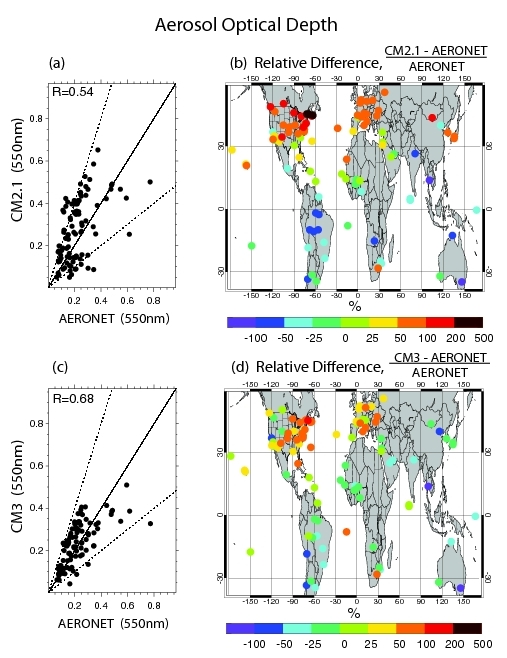
Figure
1. Climatological aerosol optical depths (550nm) from AERONET and
(a), (b)
CM2.1 and (c), (d) CM3. Dashed lines in (a) and (c) denote slopes of
0.5 and
2.
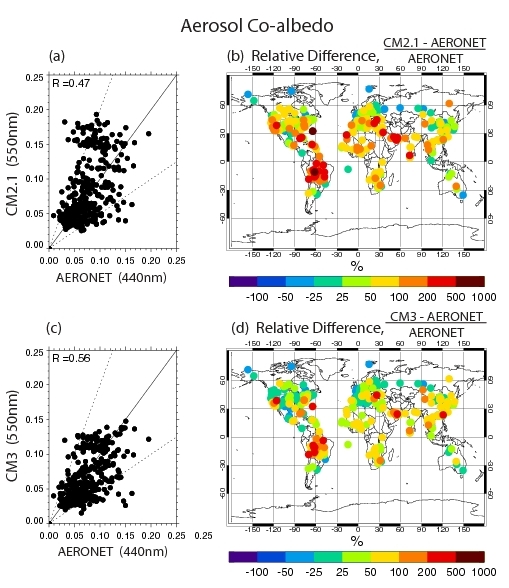
Figure2. Climatological aerosol co-albedos from AERONET (440nm) and (a),
(b) CM2.1
and (c), (d) CM3 (550nm). Dashed lines in (a) and (c) denote slopes of
0.5 and
2.
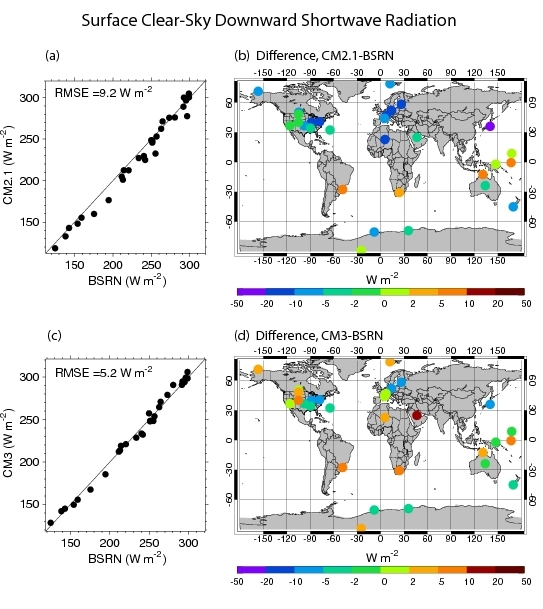
Figure 3. Surface clear-sky downward shortwave fluxes from Baseline
Surface Radiation Network (BSRN) and (a) CM2.1
and (c) CM3. Differences in these fluxes: (b) CM2.1 minus BSRN and (d) CM3
minus BSRN. Model fluxes are obtained from the clear-sky radiative transfer
code at all grid points and times (regardless of cloud characteristics),
providing consistent sampling with respect to seasonal and diurnal
cycles in CM2.1 and CM3.